
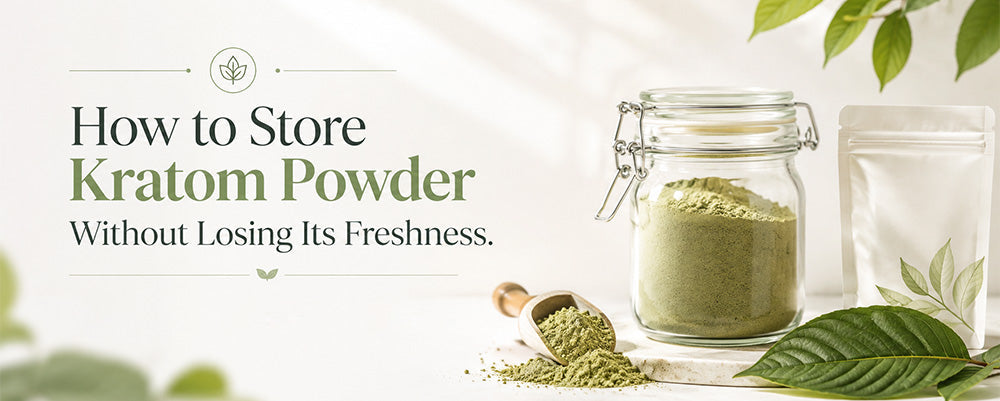
⚡ Quick Answer: What is the best way to keep your kratom fresh and potent?
The absolute best way to store kratom powder is to lock it in an airtight glass container kept inside a cool, dark, and dry space, such as a climate-controlled pantry or cupboard. Exposure to the "four horsemen" of botanical degradation—light, heat, air, and moisture—rapidly breaks down the active alkaloids (mitragynine and 7-hydroxymitragynine) that give kratom its properties. Eliminating these elements is the secret to maintaining factory-level freshness for months.
The Battle Against Staleness: Protecting Your Botanicals
If you have ever opened a leftover bag of kratom that you forgot about for a few months, you know the exact drill. You open the seal, and instead of a vibrant green color and a sharp, distinct aroma, you are greeted by a dull, faded brown powder that smells completely flat. When you try to use it, you realize the potency has taken a massive nosedive. Poorly kept botanical powders lose their integrity quickly, forcing you to use double the amount or throw your hard-earned money straight into the trash.
But it doesn't have to be that way. Imagine opening a storage jar six months from now and finding your powder looking, smelling, and performing the same as the day it arrived from the distributor.
Welcome to the ultimate guide on proper kratom storage. Because kratom is an all-natural, organic plant material, its chemical structures are highly sensitive to environmental factors. Learning how to store kratom powder correctly isn’t just about cleanliness; it’s an exercise in preservation physics that keeps your alkaloids intact down to the final gram. If you're new to kratom, check out our Complete Kratom Guide to learn more about strains, potency, and proper usage before diving into storage best practices.
Here are the core strategies you need to implement to ensure your stock never loses its punch.
The Four Environmental Enemies of Kratom
The biggest problem with casual storage is that organic plant compounds naturally oxidize when exposed to the elements. To secure the best way to store kratom powder, you must treat your storage space like a secure vault built to block out four specific elemental hazards.
Why Eliminating Environmental Exposure Matters:
-
Alkaloid Preservation: Mitragynine degrades rapidly when exposed to ultraviolet (UV) light waves, turning an active, premium strain into an inactive, stale powder.
-
Mold and Bacteria Prevention: Microscopic moisture droplets in the air create a breeding ground for mold spores. Keeping your powder bone-dry eliminates biological risks.
-
Texture and Consistency Control: Humidity causes fine botanical powders to clump up, clump together, and absorb ambient room odors, completely ruining the natural quality.
By The Numbers: Short-Term vs. Long-Term Storage Solutions
The physical container and location you choose entirely dictate how long your kratom remains fresh. Mismatching your storage style to your consumption rate leads to accidental staleness. Here is how proper storage setups compare over time:
|
Storage Horizon |
Ideal Container Type |
Best Physical Location |
Expected Shelf Life |
|
Short-Term (Daily Use) |
Original UV-blocking resealable pouch / Small glass jar |
Frequently accessed kitchen cabinet or countertop drawer |
1 to 3 Months |
|
Mid-Term (1–3 Months) |
Airtight amber glass mason jar with a secure rubber gasket |
Dark, climate-controlled bedroom closet or deep pantry shelf |
3 to 6 Months |
|
Long-Term (Bulk Buying) |
Vacuum-sealed food-grade bags with desiccant packs |
Dark storage chest kept at a stable room temperature ($60^{\circ}F$ to $70^{\circ}F$) |
6 to 12+ Months |
The Golden Rules: Technical Details of Proper Kratom Storage
We don’t want you wasting money on expensive, high-tech industrial hardware. Achieving professional-grade preservation is incredibly simple once you master the baseline mechanics of air and temperature control.
1. Lock Out Oxygen with Airtight Seals
Oxygen is a primary catalyst for biological breakdown. When kratom powder sits in an open or loosely rolled bag, it undergoes continuous oxidation. Always opt for glass jars with heavy-duty rubber latch gaskets or thick, multi-ply vacuum seal bags over simple Ziploc-style sandwich bags.
2. Maintain an Absolute Zero-Moisture Zone
Moisture is the single most dangerous element on this list because it introduces the risk of toxic mold growth. Never store your jars near a stove, dishwasher, or bathroom where steam is common. For ultimate protection, drop a small, food-grade silica gel desiccant packet inside your storage jars to instantly catch any hidden humidity. According to the National Institute of Standards and Technology (NIST), desiccants are commonly used to control moisture and protect materials from humidity-related degradation.
3. Keep the Temperature Perfectly Stable
Fluctuating temperatures create internal condensation inside sealed glass jars. Store your stock far away from heating vents, drafty windowsills, or hot appliances. Aim for a consistent, comfortable room temperature between $60^{\circ}F$ and $70^{\circ}F$.
4. Block Out All UV Light Channels
Clear glass looks beautiful on a shelf, but it lets ambient sunlight and indoor fluorescent light pass straight through to hit your powder. If you prefer using glass jars, make sure they are made of dark amber or cobalt glass, or simply keep your clear jars tucked deep inside a dark, unlit cabinet.
Pitfalls to Avoid: The Refrigerator Myth
A common piece of misinformation floating around the internet is that keeping your kratom powder in the refrigerator or freezer will make it last forever. In reality, this is a recipe for a clumpy, ruined mess.
Every time you take a cold jar out of the refrigerator into a warm room, condensation immediately forms on the inside walls of the container—just like a cold glass of iced tea on a summer day. That trapped moisture sinks directly into your fine powder, causing clumping, diluting the flavor, and drastically increasing the likelihood of mold development. Keep your stock out of the fridge and safely in a dry closet.
Frequently Asked Questions (FAQs)
1. Does kratom powder actually expire or go bad over time?
Kratom doesn't have a rigid, dangerous expiration date like dairy products, but it absolutely degrades. If kept completely dry, old kratom is generally safe to consume, but the experience will be highly disappointing. The active alkaloids break down over time, resulting in a severe loss of potency, a stale aroma, and a bitter, unpleasant taste profile.
2. Can I store multiple strains or colors together in the same large jar?
We strongly advise against mixing your strains or vein colors (like blending a Red Bali with a White Maeng Da in one jar) unless you are intentionally creating a permanent, custom blend. Different harvests possess unique terpene and alkaloid configurations; storing them together will muddy the distinct profiles and make your serving sizes highly unpredictable.
3. Should I leave the powder in its original vendor packaging?
If your vendor ships their products in thick, heavy-duty, UV-blocking aluminum foil pouches with high-quality resealable tracks, it is perfectly fine for short-term daily use. However, if the vendor uses cheap, translucent plastic bags or if the zipper track gets jammed with powder residue and fails to close completely, transfer it to a clean glass jar immediately.
4. What is the easiest way to detect if my stored kratom has molded?
Trust your senses. Fresh kratom has a sharp, earthy, green-tea-like aroma and a uniform powder consistency. If you open a container and smell a damp, musty, or sour old-basement odor, or if you visually notice dark white, grey, or fuzzy web-like clumps clinging to the powder, it has been compromised by moisture. Discard the entire container immediately.
5. Are plastic Tupperware containers acceptable for long-term use?
Plastic containers are acceptable for short-term preservation, but they are not ideal for the long haul. Many plastics are slightly porous, meaning they allow microscopic amounts of oxygen exchange over extended periods. Furthermore, plastic carries a static charge that causes the ultra-fine powder to stick stubbornly to the inner walls, creating unnecessary waste during clean-up.
6. Do desiccant packs change the flavor or quality of the herb?
Not at all. Food-grade silica gel desiccant packs are entirely inert and non-toxic. They do not emit any chemicals, smells, or flavors into your powder. Their solo mechanical job is to pull ambient moisture molecules out of the air inside the jar and lock them away, acting as a highly effective insurance policy for your botanicals.
READY TO EXPERIENCE THE DIFFERENCE YOURSELF?
Don't let light, heat, or moisture slowly drain the value and potency out of your favorite stock. Evaluate your home setup, grab a high-quality airtight container, and secure your botanical investment for a perfectly fresh session every time!