
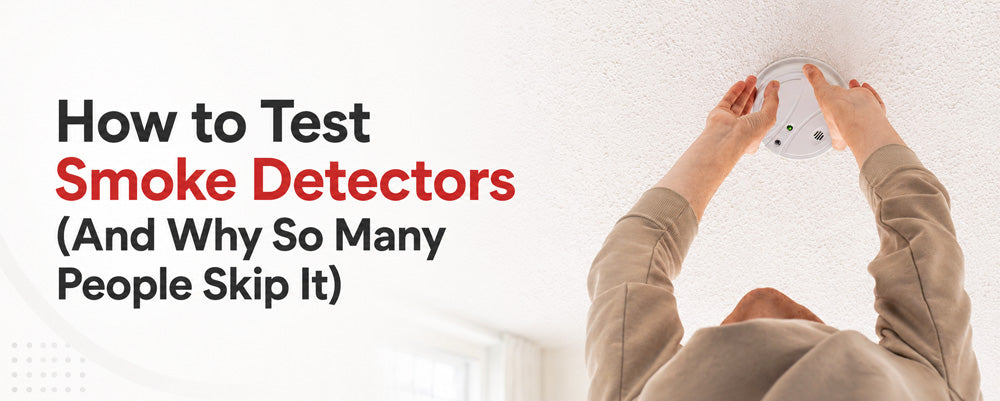
Most smoke detectors in American homes have never been tested; not once, not by the person who installed them, not by anyone. It takes about 30 seconds and one button press, yet it's one of the most commonly skipped home maintenance tasks. That gap matters: a working smoke alarm roughly halves your risk of dying in a home fire, and a large share of home fire deaths happen in properties where an alarm was present but not actually working, according to NFPA research.
If you already know you should test yours and just haven't gotten around to it, you're in good company, and the fix takes less time than it took to read this sentence. Here's exactly how to test smoke detectors properly, why so many people put off testing smoke alarms in the first place, and what to do if a unit doesn't pass.
Why So Many People Skip Testing Their Smoke Detectors
Testing smoke detectors sits in a strange category of chore: it's fast, free, and genuinely important, and people still avoid it. A few reasons come up again and again:
-
It's loud, and nobody enjoys it. A test alarm is exactly as ear-splitting as the real thing, on purpose; so people put it off the same way they'd put off any unpleasant task.
-
Out of sight, out of mind. Detectors live on ceilings, which makes them easy to forget entirely.
-
A false sense of security. A detector that's clearly there feels like it's clearly working. Most people never question a device until it fails to go off or chirps at 3 a.m.
-
Nobody's sure how. Testing feels like it should be obvious, but between different button placements, mute functions, and smart-alarm apps, plenty of people genuinely aren't sure they're doing it right.
-
Renters assume it's someone else's job. In rentals, testing often falls into the gap between "landlord's responsibility" and "nobody's actually checking."
None of these are unreasonable; they're just not good reasons to skip a check that takes thirty seconds and could matter enormously.
How Often Should You Test Smoke Detectors?
The standard guidance from the U.S. Fire Administration is simple: test every smoke detector in your home once a month. No special tools, no schedule to memorize beyond "same day each month"; the first of the month, or whenever rent is due, are easy anchors to hang it on.
Monthly testing is separate from two other maintenance tasks people often mix it up with:
-
Battery changes — typically once a year for detectors with replaceable 9V batteries, or as soon as a unit starts chirping.
-
Full unit replacement — every 10 years from the manufacture date (printed on the back of the unit), regardless of whether it still passes a test. Smoke sensors degrade with age even after the alarm still sounds fine.
How to Test Smoke Detectors the Right Way
-
Give the household a heads-up. The test alarm is exactly as loud as a real one — a quick "testing the smoke alarm" shout avoids unnecessary panic, especially with kids, pets, or sleeping housemates around.
-
Locate the test button. It's the single button on the face of the unit; no need to remove the cover or touch any wiring.
-
Press and hold for a few seconds. Most units need 3–5 seconds of pressure before they sound off; a quick tap sometimes isn't enough to register.
-
Listen for the correct pattern. A working alarm gives three loud beeps, pauses, then repeats. A single weak chirp instead of the full pattern usually means a low or failing battery, not a successful test.
-
Repeat for every detector in the home, not just the one nearest the bedroom. Codes generally call for a detector on every level, inside each bedroom, and outside sleeping areas, and each one needs to be checked individually.
-
Note the date somewhere you'll actually see it. A phone reminder beats relying on memory.
Start to finish, testing every detector in an average home takes about five minutes.
Testing Smart or Interconnected Smoke Alarms
Newer systems test a little differently:
-
Interconnected alarms (hardwired units that all sound together) should be tested one at a time, waiting for each to trigger the others before assuming the whole system works; a single faulty unit can break the chain.
-
Smart alarms (Nest Protect, First Alert smart models, and similar) often test through a companion app alongside the physical button, and will usually push a phone notification if a self-check fails between manual tests.
-
Combination smoke/carbon monoxide alarms typically test both sensors with the same button press, but confirm the beep pattern for each; they're often different, and it's worth knowing which is which before an actual emergency makes it obvious. (See our carbon monoxide detector testing guide for the full breakdown.)
What to Do If a Smoke Detector Fails the Test
No sound at all; Replace the battery first. If it still doesn't respond, the unit itself has likely failed and needs replacing, not just the battery.
Chirping instead of a full alarm. This is the universal signal for "battery low." Replace it, then re-test to confirm the full three-beep pattern returns.
Alarm sounds without being tested (false alarms); Usually dust, steam, or cooking smoke rather than an actual fault. Gently vacuum the vents on the unit with a soft brush attachment; if false alarms continue, the sensor itself may be failing.
The unit is over 10 years old. Replace it even if it passes every test. This is the one case where a "working" alarm still isn't a safe one; smoke sensors lose sensitivity well before they stop making noise.
Smoke Alarm Testing, Batteries, and Replacement: The Full Schedule
-
Monthly: Press the test button on every detector.
-
Twice a year: Gently vacuum each unit to clear dust — tying it to the clock change is an easy way to remember.
-
Annually: Replace 9V batteries, even if they haven't started chirping yet.
-
Every 10 years: Replace the entire unit, checking the manufacture date on the back. Sealed 10-year lithium battery units get replaced as a whole rather than having their battery swapped.
FAQs
How long do you need to hold the test button?
Around 3 to 5 seconds. A quick tap sometimes doesn't register; hold until you hear the full alarm pattern, not just a click or a single beep.
Why does my smoke detector still chirp after I changed the battery?
Usually one of three things: the battery isn't seated correctly, it's the wrong type for that model, or the unit itself has an internal fault. Try reseating a fresh battery first; if the chirping continues, the detector likely needs replacing.
Can you test a smoke detector without pressing the button?
Some people use smoke from a blown-out match or candle to trigger the sensor directly, but this isn't recommended for routine testing — it's harder to control, sets off the alarm unpredictably, and the test button already checks the same circuit safely.
Is it normal for a smoke detector to be extremely loud when tested?
Yes. Smoke alarms are required to be loud enough to wake a sleeping adult, typically around 85 decibels at close range. That volume is intentional and isn't a sign anything's wrong.
How do I test a hardwired smoke detector?
The same way as a battery-powered one: press and hold the test button. If it's interconnected with other alarms, confirm the others sound too, since that's the main thing hardwiring adds.
Final Thoughts
Testing smoke detectors is one of the few home safety habits that costs nothing, takes less than a minute, and has an outsized effect on how a genuine emergency plays out. The hardest part isn't the test itself; it's remembering to do it before you need it to work.
Pick a monthly reminder that'll actually stick, test every detector in the home rather than just the closest one, and treat the 10-year replacement mark as non-negotiable no matter how "fine" a unit seems. Pair the habit with reviewing your home fire escape plan once a year, since the two go hand in hand. If you haven't checked yours this month, this is a good moment to go do it.